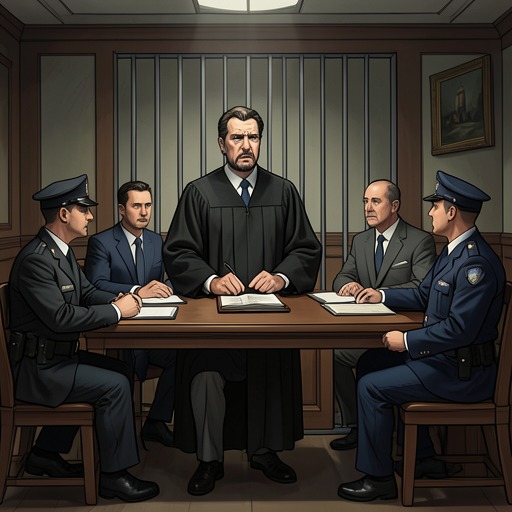
Preliminary hearing
The RoomThe Preliminary hearing is the Unnamed protagonist’s first sustained encounter with the formal court process after his arrest, and it turns procedure into a source of alienation rather than reassurance. He pleads not guilty, but cannot make sense of much of the language used around him; his effort to monitor the evidence gives way to frustration as his lawyer fails to challenge what he sees as weaknesses in the testimony. The judge denies the defense motion to dismiss, and the protagonist leaves the Courtroom convinced that neither the proceedings nor his appointed advocate has meaningfully served him.
Background and Setting
Before the hearing, the Unnamed protagonist drafts an address to the public that presents policing as part of a creeping Police State. He argues that the mass of obscure laws leaves even law-abiding people vulnerable to enforcement, and that police can use such laws to harass citizens. These are his claims, not findings made by the court, but they establish the suspicion through which he interprets the hearing: legal authority appears to him less like a neutral safeguard than a set of tools controlled by others.
The hearing begins with charges being read while he stands. He recognizes a few words but experiences most of the formal language as unintelligible. He knows that the occasion is real, yet cannot grasp much beyond that. When the judge asks for his plea, he answers not guilty. The public defender beside him gives him paper and a pencil and instructs him to write down questions rather than speak during witness testimony, explaining that he cannot listen to both the defendant and the prosecution at once. The protagonist accepts the materials without response, already treating the lawyer as a stranger whose presence offers little assurance.
Proceedings and Ruling
The arresting officers are the first witnesses. The protagonist intends to follow their testimony closely, note discrepancies, and provide his lawyer with points that might weaken the prosecution’s case. Instead, he repeatedly begins to write and finds that he cannot put his thoughts into words. As the testimony continues, his frustration grows; he leans farther back, and eventually the pencil rests unused on the paper.
Much of the hearing proceeds through stipulations and waivers. The attorneys agree to matters for the purposes of the preliminary proceeding, and the judge records them; further items are waived and noted. The public defender then asks for dismissal on several grounds, citing legal cases and decisions. The prosecuting attorney argues against dismissal and cites authorities in response. After a brief recess in which the judge withdraws to chambers, the judge refers to the lawyers’ citations, adds several of his own, and denies the motion. Questions and answers continue, but the protagonist sees his lawyer as allowing matters to pass without effective challenge. His perception is not presented as a legal assessment of the arguments; it is the immediate judgment of a defendant who expected his counsel to identify and contest weaknesses and believes that this has not happened.
The Long Day and Its Aftermath
The protagonist cannot say how long he spends in the Courtroom, but experiences the proceedings as drawn out and interminable. The route back to his cell compounds that impression: he waits, rides an elevator to holding tanks, waits for his clothes, is cuffed to a chain, travels by bus to the courthouse, passes through another holding area, and then makes the return journey through holding tanks and transport. He later recalls being awakened at about 5:30 for court and reaching his cell after 7:30, describing the day as fourteen hours. Yet when he mentally reviews the details, the hours collapse into minutes. Time seems both unbearable while it is being endured and strangely compressed in recollection.
Back in his cell, he regards the sequence of legal formalities as a self-perpetuating ritual: stipulations, waivers, questions, answers, and decisions seem to continue because the process itself keeps moving. He imagines that he should have interrupted it, pushed aside his lawyer, and taken control of the argument. This is a fantasy of agency after the fact, not an action he took in court. He ends by diminishing the hearing’s importance as only preliminary and assuring himself that the next time, when the stakes are greater, he will not let the rules defeat him.
Continuing Conflict with Counsel and Procedure
The hearing’s central conflict is between formal participation and the protagonist’s felt inability to participate effectively. He is physically present, enters a plea, receives a means to record questions, and watches his lawyer argue a motion; nevertheless, he experiences the legal language as inaccessible and his own observations as impossible to express. The judge’s denial of dismissal is a concrete procedural outcome, but the protagonist’s lasting conclusion is that his counsel did not try hard enough and that the proceeding passed him by.
Later, during his trial, the court reminds him that he had insisted on acting as his own counsel despite contrary advice and the availability of a public defender. The judge offers him another opportunity to accept representation, and he declines. That later choice complicates the earlier hearing: his distrust of the public defender is real within his account, but his subsequent rejection of counsel also makes self-representation part of his own strategy. His later complaints about being unable to defend himself coexist with a documented refusal of representation, leaving the conflict between institutional restriction and his determination to take control unresolved.